|
FDRHPO Releases Findings of 11th Annual Community
Health Survey
Published: September 26, 2026
at 11:00 a.m.
By: Press Release from Fort Drum Regional Health
Planning Organization (FDRHPO)

FDRHPO Releases Findings of 11th Annual
Community Health Survey
2026 survey highlights increased preventative cancer screenings,
identifies affordability pressures,
and challenges accessing care
 Watertown, NY – The 11th
Annual Community Health Survey of adults in Jefferson, Lewis, and St.
Lawrence counties is now complete. The 2026 results show encouraging gains
in routine cancer screenings and dental care, while also identifying
affordability, declining self-reported health, and growing barriers to
local healthcare as key concerns. Watertown, NY – The 11th
Annual Community Health Survey of adults in Jefferson, Lewis, and St.
Lawrence counties is now complete. The 2026 results show encouraging gains
in routine cancer screenings and dental care, while also identifying
affordability, declining self-reported health, and growing barriers to
local healthcare as key concerns.
Each year, the
Fort Drum Regional Health Planning Organization (FDRHPO) conducts a
Community Health Survey to better understand the health behaviors,
concerns, and needs of residents across Jefferson, Lewis, and St. Lawrence
counties. The 2026 survey examined affordability and food security, housing
stability, concerns about aging, chronic conditions, self-reported
physical, mental, and dental health, trust in health information,
healthcare access, and use or consideration of GLP-1 weight-loss
medications.
Survey questions
are developed and updated annually by North Country Health Compass
Partners, a group that includes representatives from Jefferson, Lewis, and
St. Lawrence County public health departments, hospitals, healthcare
facilities, behavioral health clinics, and a wide range of community-based
organizations dedicated to community wellness. Some questions stay the same
from previous years, while others are newly created each year to address
current needs.
“The Community
Health Survey is a resource that our stakeholders look forward to each year,”
said Kayla Quinn, Population Health Coordinator at Fort Drum Regional
Health Planning Organization (FDRHPO). “The data collected and released showcases
the health needs of the community, and we can tailor the survey questions from
year to year as we monitor health trends from previous years. It’s a
valuable resource for our partners and our communities.”
Key findings:
·
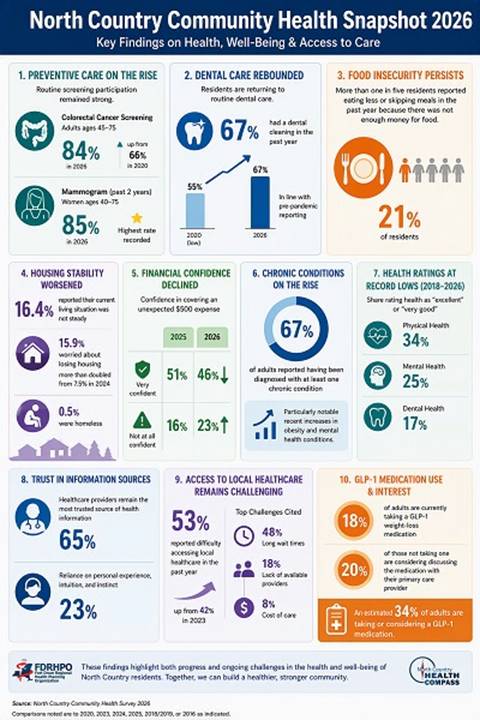
Routine cancer screening participation remained
strong. Among adults ages 45 – 75, 84% reported having a colorectal cancer
screening, a significant increase from 66%. Among women ages 40 – 75, 85%
reported having a mammogram within the past two years, the highest rate
recorded.
·
Routine dental care also showed a positive rebound. 67%
of North Country residents reported having a dental
cleaning within the past year, up significantly from the 2020 low of 55%
and now in line with pre-pandemic reporting.
·
More than one in five residents (21%) reported eating
less or skipping meals in the past year because there was not enough money
for food.
·
Housing stability worsened: 16.4% reported that their
current living situation was not steady, including 15.9% who were worried
about losing their housing and 0.5% who were homeless. Concern about losing
housing more than doubled from 7.5% in 2024.
·
Confidence in covering an unexpected $500 expense
declined. The share who were “very confident” fell
from 51% in 2025 to 46% in 2026, while those who were “not at all
confident” rose from 16% to 23%.
·
Two-thirds of adults (67%) reported having been
diagnosed with at least one chronic condition, with particularly notable
recent increases in obesity and mental health conditions.
·
From 2018 to 2026, the share of respondents rating
their health as “excellent” or “very good” reached record lows, declining to
34% for physical health, 25% for mental health, and 17% for dental health.
·
Healthcare providers remained the most trusted source
of health information at 65%, down from 70% in 2016. Reliance on personal
experience, intuition, and instinct rose from 12% in 2016 to 23% in 2026.
·
More than half of residents (53%) reported difficulty
accessing local healthcare in the past year, up from 42% in 2023. Long wait
times were the leading challenge at 48%, followed by a lack of available
providers at 18%; cost of care was cited by 8%.
·
Eighteen percent of adults reported currently taking a GLP-1 weight-loss medication. Among those not taking
one, 20% said they were considering discussing the medication with their
primary care provider, an estimated combined 34% of adults taking or
considering a GLP-1 medication.
“The annual Community
Health Survey helps turn local data into meaningful action. The 2026
findings show that affordability, housing stability, chronic conditions,
and timely access to providers are the most pressing challenges for North
Country residents. These results give our partners a clearer picture of
where focused outreach, collaboration, and resources are needed most,” said Pat Fontana, Deputy Director at FDRHPO.
Now in its 11th
year, the annual Community Health Survey continues to provide valuable data
on community health perceptions, conditions, and behaviors. The 2026
insights will help regional stakeholders identify disparities, align
resources, and target the most pressing needs of North Country residents.
“The insights
gained from the Community Health Survey are invaluable. This data not only
highlights the unique challenges our rural communities face but also
empowers stakeholders to develop targeted, effective solutions that address
the specific health-related needs of Jefferson, Lewis, and St. Lawrence
counties,” said Mr. Fontana. “Our goal is to leverage these findings to
make informed decisions that will improve health outcomes across the
region.”
Questions and
comments can be directed here. For a
full copy of the 2026 Community Health Survey, please contact FDRHPO.
For additional
information, please contact Kayla Quinn by emailing kquinn@fdrhpo.org.
|