|
Attorney General Warns New Yorkers About “Pig
Butchering” Investment Scams
Published: February 17, 2026
at 04:00 p.m.
By: Press Release
from Office of NYS Attorney General
CONSUMER
ALERT:
Attorney General James Warns New Yorkers About “Pig Butchering” Scams
NEW YORK – New York
Attorney General Letitia James today issued a consumer alert and an online guide to protect New Yorkers from
“pig butchering” scams, in which fraudsters befriend victims under false
pretenses and convince them to make fraudulent investments. Scammers use
the phrase “pig butchering” to refer to their schemes in which they “fatten
up” victims by gaining their trust before finally taking their money.
Attorney General James is encouraging New Yorkers to follow the Office of
the Attorney General’s (OAG) guide to protect themselves and report these
schemes to the respective platforms involved and to OAG.
“Heartless
scammers are using increasingly sophisticated means to prey on communities
looking for connection and opportunity,” said Attorney General
James. “These fraudsters go to great lengths to gain trust and convince
people to send them their savings, sometimes ruining their victims’
finances. I encourage all New Yorkers to remain vigilant and contact my
office if they or a loved one is affected by one of these scams.”
Pig butchering
schemes typically target victims through social media, dating apps,
unsolicited text messages, or ads. After establishing a connection, the
scammers will generally transition the conversation over to an encrypted
chat platform, such as WeChat or WhatsApp, that can shield their identity
from law enforcement. Scammers typically spend a substantial amount of time
making victims believe that they are in a close personal relationship, such
as romantic partners or friends, or in a professional relationship with a
trustworthy financial advisor.
After scammers
gain the confidence of their victims, they introduce them to a trading or
investment opportunity, often in cryptocurrency or foreign currencies. To
reinforce the appearance of success, the scammer may share fake screenshots
showing how much they have made on trading platforms or send photos of the
expensive houses, jewelry, or cars they supposedly own. The scammer may
also refer victims to fraudulent websites that appear to belong to a
legitimate bank or investment firm, but with a slightly altered name.
From there,
victims are led to believe that they are making incredible returns with the
help and expertise of the scammer. Throughout the scam, victims typically
see their account balances increase on purported online statements or
investment platforms. In turn, the victims continue to place more trust in
the scammer and invest more funds. After the victims have deposited
substantial sums of money into the scammer’s platform, ranging from tens of
thousands to over a million dollars, they will be unable to withdraw their
funds or will be asked to prepay fake withdrawal fees or taxes with the
promise that their investment gains will be released. Eventually, the
scammers will cut off contact and keep their victims’ money.
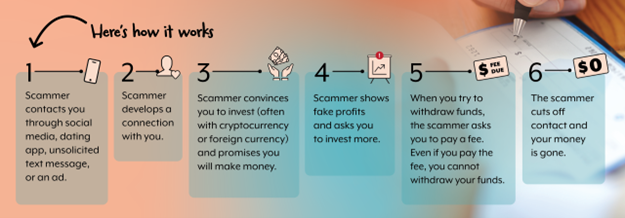
Anatomy of how a pig butchering scam works
Attorney General
James recommends simple steps for New Yorkers to follow to avoid
becoming the victim of a pig butchering scam or any other fraudulent
schemes. These include being suspicious of anyone who:
- Warns you not to tell anyone about your
relationship with them or the investment opportunity they’re offering.
- Interferes when your bank or brokerage questions a transaction
they have instructed you to do.
- Asks you for personal financial information
or private photographs, which could later be used to extort you.
- Promises to meet you in person or over video, but always finds an excuse not to meet. Keep
in mind that even video calls can be faked.
- Instructs you to hand cash or a check to a
courier or delivery person, or to use a bitcoin ATM.
- Requests to move your conversation from text
and email to WeChat, WhatsApp, or other encrypted platforms.
Attorney General
James also urges New Yorkers to:
- Avoid wiring money, sending cryptocurrency,
or giving cash to people you don’t know. These transactions cannot be
reversed.
- Research the person soliciting. Do web
searches to see whether their image, name, or details appear elsewhere
online – and whether they have been faked or belong to someone else.
Scammers may use stolen identities, or could
use AI to generate their profiles and pictures.
- Beware if someone pressures you to invest
within a very short time frame, and claims
you will lose out on an opportunity.
- Consult a trusted legal professional or
financial advisor who can advise you on investment
opportunities.
- Never rush into any investment. If it seems
too good to be true, it probably is.
- Report the individual to the respective
platform and to law enforcement if you suspect fraud. Save all
communications so that you can provide them to
law enforcement if needed.
Attorney General
James encourages anyone who may have been a victim of this type of scam to
report it to OAG by filing a complaint online or calling 1-800-771-7755. Any
identifying information provided to OAG will be
protected according to law and policies on the safeguarding of identifying
information.
###
|