|
Jury Delivers Guilty Verdict for First-Degree
Manslaughter in Vanbergen Trial
Published: June 20, 2025 at
10:35 p.m.
By: Julie Abbass, independent journalist, for
linkinglewiscounty.com
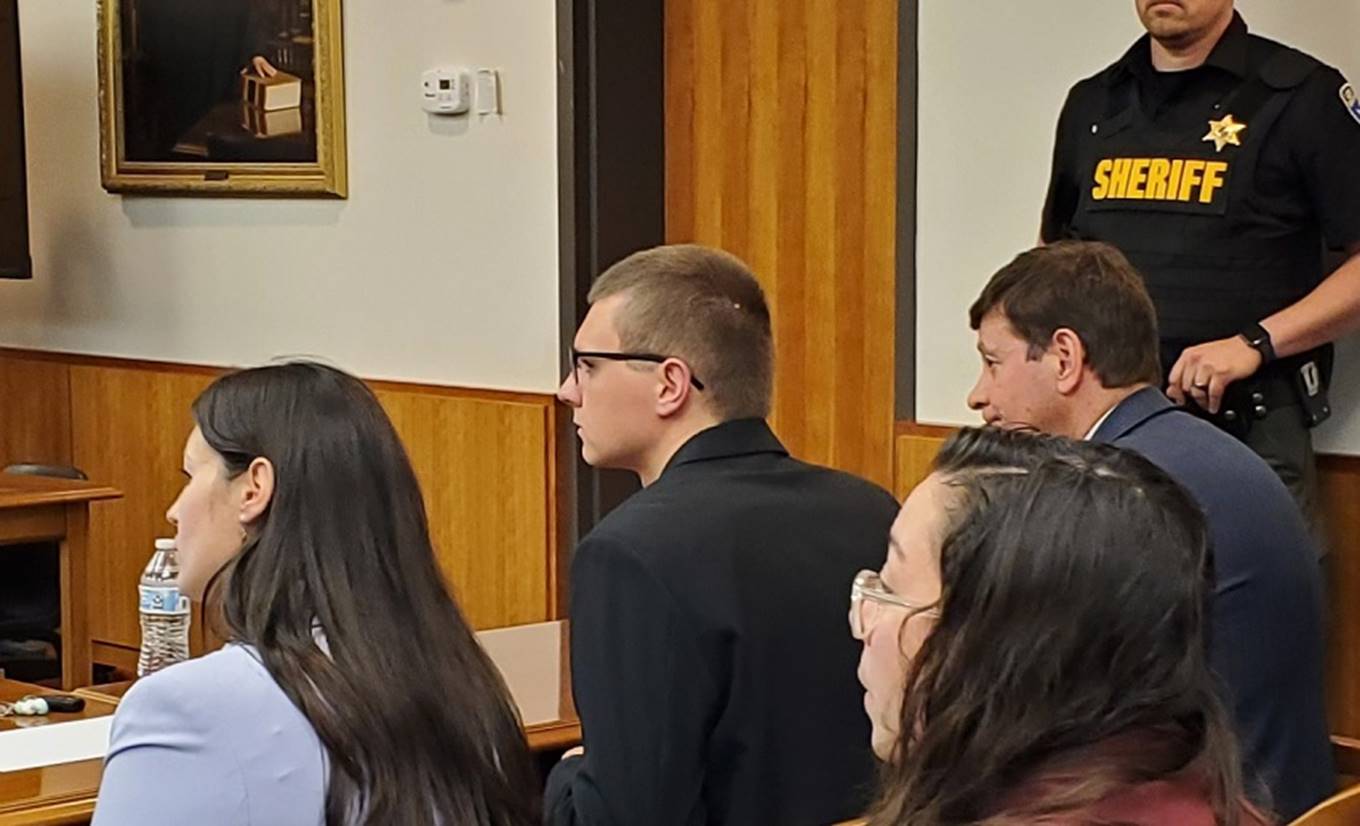
Jacob M. Vanbergen, front center, listens as the
verdict in his trial is read in Lewis County Court on June 20, 2025
Pennsylvanian found guilty of intentional
manslaughter
LOWVILLE, NY – Following
hours of closing arguments, the addition of three lesser charges to consider
and an afternoon of wading through evidence, jurors in Jacob M. Vanbergen’s
murder trial found him guilty of first-degree manslaughter.
The 25-year-old
Pennsylvanian intentionally strangled his boss and “best friend” Brandon J.
Shepker, 39, also from Pennsylvania, using the
hooded sweatshirt Shepker was wearing when an
argument between them turned physical on January 6, 2024, at Ridge View
Lodge on state Route 12 in the town of Lowville. The strangulation resulted
in Mr. Shepker’s death, as determined by an
autopsy.
The men came to
Lewis County together to look at real estate opportunities and enjoy the
snowmobile trails, according to information Mr. Vanbergen provided to prosecutors.
Mr. Vanbergen was
originally indicted for second-degree murder by a grand jury on June 6,
2024, but Lewis County Court judge, Hon. Daniel R. King, informed the jury
that the prosecution and defense agreed to add three lesser charge options:
·
First-degree manslaughter
·
Second-degree manslaughter
·
Criminally negligent homicide
Before beginning
their deliberation today, after two weeks of testimony and evidence, jurors
were informed that Mr. Vanbergen could only be found guilty of one of the
charges and that they should look at the original second-degree murder
charge first. If he was not guilty on that charge, they should consider the
next.
Judge King read a
detailed explanation of each of the charges including definitions of key
words, like intent, and gave specific instructions on what jurors needed to
determine the evidence proves for this particular case.
For second-degree murder, the jury needed
to see that Mr. Vanbergen’s intent --- his purpose --- was to cause the
death of Mr. Shepker. Judge King told the jury
they should examine what Mr. Vanbergen said and did before and after the strangulation
to determine if any of his “conduct” contributed to Mr. Shepker’s
death, though it did not need to be the only cause. They also needed to be
sure beyond a reasonable doubt that death was the most likely “foreseeable result”
of those actions even if it was not inevitable.
The first-degree manslaughter charge
jurors ultimately applied to Mr. Vanbergen’s role in the victim’s death was
the only other option that included intentional action according to the
information the judge provided. Judge King said the jury had to conclude
that the defendant’s intention was to cause serious injury to the victim
which in turn caused his death.
The second-degree manslaughter charge
required the evidence prove Mr. Vanbergen caused the victim’s death with
reckless conduct --- defined as doing something that could have been predicted, or foreseen to contribute to the victim’s
death which was ignored even though death was not their intention.
Criminally negligent homicide would have
been the most appropriate charge if the jury found Mr. Vanbergen’s actions
to be so serious that death was likely to occur even if death was not the
goal.
Judge King
explained to the jury they could only find Mr. Vanbergen guilty of one
charge, starting with second-degree murder. If they did not find him guilty
of that, they were told to move on to first-degree manslaughter for a
potential conviction.
Before arriving
at their final verdict, the jury requested clarification of the charges
twice and to rewatch certain evidence.
The jury’s first
request was at 1:20 pm, less than an hour after deliberation began at 12:45
p.m., when they asked for the explanations and definitions of the four
charges to be given to them in writing. Judge King read the basic
qualifiers for each charge to reach a guilty verdict for Mr. Vanbergen but
said he could not provide the information in writing.
A few hours
later, the jury again asked to see the definition of “serious bodily harm,”
which the judge read to them out loud.
Jurors also asked
to watch the video evidence of two Pennsylvania officers interrogating Mr.
Vanbergen when he admitted for the first time that he strangled Mr. Shepker, stating he thought Mr. Shepker
was only unconscious.
During the
closing arguments, the question of intent was raised by defense attorney
Gary W. Miles and District Attorney Jeffrey G. Tompkins.
The attorneys
interpreted Mr. Vanbergen’s actions very differently.
From Mr.
Vanbergen’s return to the hotel room after leaving Mr. Shepker
in a state he claimed he thought was unconsciousness on the floor to his
relaxed and unrushed walk down the hotel hallway as shown in security video
footage and his performance of CPR on Mr. Shepker
rigorously enough to sweat were among the defendant’s actions that received
the same question from Mr. Miles during his final wrap up: “Does that sound
like a murderer?”
Mr. Miles also
emphasized that he believed, based on the testimony given by the forensic
expert he called to the stand, that the autopsy performed was “only half of
an autopsy” because it did not consider Mr. Shepker’s
medical issues and blood alcohol content, with tramadol also present, as potential
additional causes of his death, although his witness did agree with the
autopsy’s strangulation finding.
Although Mr.
Tompkins echoed Assistant District Attorney Joseph H. Hobika
III’s opening statement that proving the motive was not required, he spent
considerable time in his closing argument supporting greed as the motive. He
highlighted that Mr. Vanbergen did not just go to a bar after strangling
his friend but also bought a round of drinks, was found to be in a
“friendly” and engaging mood by a local person standing in front of the bar
and the bartender, and then tipped the bartender
$20 --- behavior the DA characterized as a “celebration.”
Mr. Tompkins also
reminded the jury the bartender testified that Mr. Vanbergen told her he
owns a business in Pennsylvania “because he honestly thought it was true”
since he thought he would inherit Mr. Shepker’s
business he knew was worth about $865,000. To that point, however, he only
worked for Mr. Shepker.
The DA went
through Mr. Vanbergen’s actions upon his return to Pennsylvania, including
immediately searching for the will; removing a truck, snowmobile trailer
and two snowmobiles from Mr. Shepker’s property
and only returning one snowmobile when pressed to bring them all back
because both his and Mr. Shepker’s names were
both listed as owners; and claiming that Mr. Shepker
told him he would inherit everything some day and to keep the key and
important documents out of the hands of his mother and brother, who both
testified about their relationships with the deceased.
Family members of
Mr. Shepker and Mr. Vanbergen were in the
courtroom every day of the trial.
When the verdict
was given, tears could be seen traveling down faces on both sides. sobs
echoing around the space.
“This is the last
thing I could do for my son,” said Diane Shepker,
the victim’s mother, with his brother Joe Shepker
by her side. “I wish it was more but I’m glad it’s not less.”
Mr. Vanbergen
showed only subtle reactions throughout the closing arguments and none as
the verdict was read. He was quietly escorted out and returned to custody. The
strain could be seen in his father’s face, his girlfriend’s demeanor,
culminating in tears and disbelief as they quickly made their way out of
the courtroom, preferring not to make a statement.
Mr. Miles said he
was surprised the jury found his client guilty of first-degree manslaughter
because it involved intent to physically harm. He
said he thought unintentional manslaughter was the most likely charge if
Mr. Vanbergen was to be found guilty. The public defender confirmed he will
file an appeal on Mr. Vanbergen’s behalf as is required for all
public defenders
in this type of case.
First-degree
manslaughter comes with a potential sentence of 5 to 25 years.
Sentencing is scheduled to
take place in Lewis County Court on August 5 at 9 a.m.
|


