|
Fort Drum Regional Health Planning Organization Promotes
Colorectal Cancer Screening Through Regional Partnerships
Published: March 10, 2025 at
03:45 p.m.
By: Press Release from Fort Drum Regional Health
Planning Organization
 
Fort Drum Regional Health Planning Organization Promotes
Colorectal Cancer Screening Through Regional Partnerships
 Watertown, NY – Fort Drum
Regional Health Planning Organization (FDRHPO) is nearing the successful
completion of an 18-month grant from Exact Sciences, a leading provider of
cancer screening and diagnostic tests, to improve colorectal cancer screening
rates and make healthcare more accessible throughout the North Country
region. Watertown, NY – Fort Drum
Regional Health Planning Organization (FDRHPO) is nearing the successful
completion of an 18-month grant from Exact Sciences, a leading provider of
cancer screening and diagnostic tests, to improve colorectal cancer screening
rates and make healthcare more accessible throughout the North Country
region.
The grant promoted
colorectal cancer screenings among marginalized elderly, low-income, and
disabled populations throughout New York’s rural Jefferson, Lewis, and St.
Lawrence counties by supporting the region’s primary care practices in
identifying and outreaching eligible patients and promoting awareness of
colorectal cancer screening through a multimedia campaign.
The grant was
made possible through Exact Sciences’ Funding Opportunities for Colorectal
Cancer Screening Uptake Strategies (FOCUS) Program, which provides funding
to community organizations, health foundations, public health
organizations, and advocacy groups working to increase access to colorectal
cancer screening. Exact Sciences developed Cologuard®, the first
and only FDA-approved, noninvasive, multi-target, stool-based DNA screening
test that people can use at home.
“Colorectal
cancer is one of the most preventable cancers, yet approximately 60 million
average-risk Americans remain unscreened1,” said Paul Limburg,
Chief Medical Officer of screening, at Exact Sciences. “Awareness and
access are critical to increasing screening participation, and Exact
Sciences is honored to support these organizations that are driving
screening uptake and addressing inequities within their communities.”
FDRHPO utilized
data provided by Medicare and Managed Medicaid insurers to identify
patients in the region who were due for colorectal cancer screening and
worked with eleven primary care partners to outreach patients and track
screening completion. Through its Communications Committee, FDRHPO also
collaborated with other primary healthcare, inpatient, behavioral healthcare,
and social care providers in the region to develop a marketing campaign.
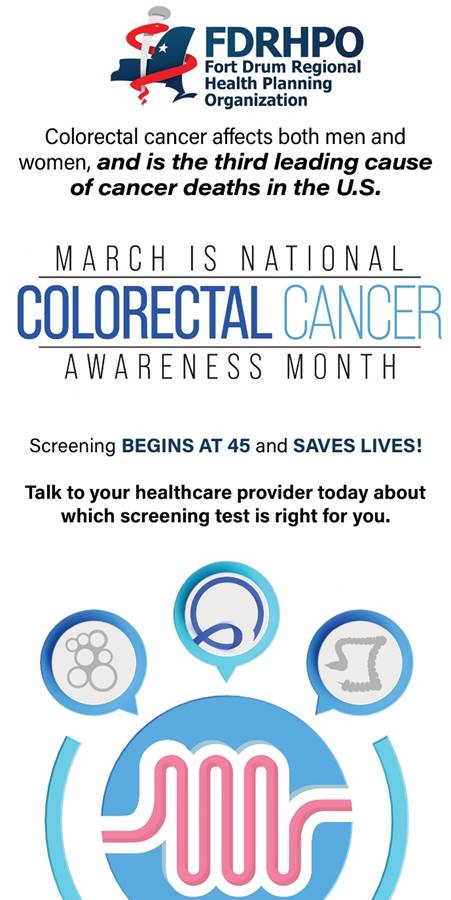
The campaign included messaging that screening generally starts at age 45;
both men and women need to be screened; when caught early enough, roughly
90% of those diagnosed will successfully treat it; and that individuals
should talk to their healthcare provider to determine which screening
option is best for them.
The primary
project goal was to complete 1,250 colorectal cancer screenings among the
target population; at the time of writing, FDRHPO and its partners have
exceeded the goal, having completed nearly 1,500 screenings thus far.
Further, the media campaigns were successful, with over one million
impressions and more than 1,200 ‘engagements’ (often, when an individual
clicks on the digital graphic for more information). FDRHPO houses a
collection of educational graphics about colorectal cancer screening on its
website at https://www.fdrhpo.org/colocancerresources;
providers and the general public are invited to utilize and share these at
no cost.
“FDRHPO is grateful
to have received this grant,” said Erika Flint, executive director of
FDRHPO. “The most marginalized patient populations often go unscreened for colorectal
cancer,1 so we’re thrilled that this grant helped us improve education
and access to screening within our community, ultimately saving lives.”
“Colorectal
cancer is one of the leading causes of cancer worldwide, but most
colorectal cancers arise from precancerous polyps in the colon,” said Dr.
Christopher Kellogg, provider at Watertown Internists. “Early detection is
key and therefore routine screening can prevent colorectal cancer by
detecting and removing premalignant polyps before they progress. Talk to
your provider about colorectal screening options.”
Ms. Flint added,
“This grant is one of several initiatives that FDRHPO and its partner,
North Country Initiative (NCI), have designed and implemented in concert
with dozens of clinical, behavioral, and social care partners in the region
to support preventive and primary care, the prevention and management of
chronic disease, and behavioral healthcare and substance use prevention and
management.”
In addition to
the colorectal cancer screening grant, FDRHPO and NCI collaborate with
partners to impact a host of regional health behaviors and outcomes. Examples
of collaborative regional initiatives include:
·
A separately funded project to promote breast cancer
screening through the use of mobile mammography equipment in community
“hotspot” locations;
·
A three-year initiative to place community health
workers in primary care practices to promote a range of preventive and
chronic care among North Country patients;
·
Financial and technical support to primary care and
behavioral care partners to provide transitional
and chronic care management services to Medicaid-insured populations, for
whom such services are not otherwise available. Recent analysis indicated
that transitional care management services for Medicaid-insured patients in
the region are linked to a 40% reduction in 90-day post-discharge
healthcare costs, 14% lower inpatient readmission rates, and a 36% increase
in documentation of social care needs;
·
Regional media campaigns, such as “Call Us First”
which encourages people to contact their primary care team for minor acute
needs, and “Healthy Habits” which encourages people to re-engage in primary
and preventive care, notably annual wellness visits, recommended
screenings, dental/oral care, and immunizations;
·
Adoption of a standardized screening tool that
clinical and behavioral providers use to identify social needs among those
they serve, document identified needs and make ‘closed loop’
referrals to relevant services;
·
A qualitative and quantitative research project to
uncover perspectives and trends about accessing and experiencing primary
care among elderly, low-income, and/or disabled regional residents, with
recommended action steps for primary care, behavioral healthcare, and
health insurance providers;
·
Provision of trainings to
clinical, behavioral, and social care staff to improve understanding of,
relationships with, and strategies to impact their patient populations;
·
Implementation of multiple value-based payment
arrangements, whereby groups of clinical and behavioral partners
collaboratively seek to steward the healthcare costs and improve quality
measure compliance among more than 26,000 patients in the region; and
·
Financial awards to more than a dozen clinical,
behavioral, and social care organizations since 2021 to pilot or conduct
“promising practice” interventions, including projects to reduce fall risk
among elderly or disabled individuals; increase management of high blood
pressure and diabetes; use telemedicine and remote patient monitoring to
treat behavioral and substance use needs and better manage patients with
chronic conditions; deploy community health workers to connect people to
clinical and social resources; and promote transitional and chronic care
management, childhood immunizations, and well-child visits.
“Since its
inception in 2005, FDRHPO has developed broad and deep relationships with
regional partners across the healthcare continuum,” shared Ms. Flint. “Our
mission to strengthen the system for health for everyone in Jefferson,
Lewis, and St. Lawrence counties supports our role as a neutral convener to
identify data-driven priorities and leverage resources to address those
priorities. The robust portfolio of work with partners – inclusive of the
colorectal cancer screening grant from Exact Sciences – to improve quality
measure rates demonstrates this commitment.”
About the Fort
Drum Regional Health Planning Organization
FDRHPO works to strengthen the system for health for the integrated
Fort Drum and civilian community through analysis, identification of needs
and leveraging of resources to fill gaps through innovation and
collaboration. For more about FDRHPO, visit www.fdrhpo.org.
About the North
Country Initiative
The North Country Initiative (NCI) is a partnership of hospitals,
independent physicians and community providers working together to reform
the healthcare system in across Jefferson, Lewis, and St. Lawrence
counties. Together, these partners carry out strategies to coordinate
leadership, align incentives, create clinical programs, and develop
technical infrastructure. The outcome of these changes will improve the
health of the community, reduce the cost of healthcare, and improve the care for patients. For more information about NCI,
visit www.northcountryinitiative.org.
About Exact
Sciences Corp.
A leading
provider of cancer screening and diagnostic tests, Exact Sciences gives
patients and healthcare professionals the clarity needed to take
life-changing action earlier. Building on the success of the Cologuard®
and Oncotype® tests, Exact Sciences is investing in its pipeline
to develop innovative solutions for use before, during, and after a cancer
diagnosis. For more information, visit ExactSciences.com, follow Exact
Sciences on X (formerly known as Twitter) @ExactSciences, or find Exact
Sciences on LinkedIn
and Facebook.
NOTE: Exact
Sciences and Cologuard are trademarks or registered trademarks of Exact
Sciences Corporation. All other trademarks and service marks are the
property of their respective owners.
About the FOCUS
Program
Launched in June
2022, Exact Sciences’ Funding Opportunities for CRC Screening Uptake
Strategies (FOCUS) Program provides grant funding to community
organizations, health foundations, public health organizations, and CRC
advocacy groups to expand access to colorectal cancer screening and create
affordable pathways to follow-up diagnostic care. FOCUS reflects Exact
Sciences’ ongoing commitment to meet people where they are and offer solutions to overcome barriers to care, regardless
of a patient’s race, ethnicity, gender identity, socioeconomic status, or
geographic location. Submissions are reviewed via Exact
Sciences’ corporate grants process, which is fully
independent from sales and marketing activities. Funding
decisions are based solely on the strength of the application and
alignment with FOCUS Program objectives, without regard to any
actual or potential commercial relationships with potential grantees. Learn
more about the
FOCUS Program.
References:
1. Ebner DW, Kisiel
JB, Fendrick AM, et al. Estimated Average-Risk Colorectal Cancer
Screening-Eligible Population in the US. JAMA Netw
Open. 2024;7(3):e245537
2. American Cancer
Society. Colorectal Cancer Facts & Figures 2023-2025. Atlanta: American
Cancer Society; 2023.
###
|


