|
DEC and The Nature Conservancy Announce 768-Acre
Conservation Easement to Protect Water Quality in the Black River Valley
Published: January 06, 2025
at 05:30 p.m.
By: Press Release
from NYS DEC
DEC and The Nature Conservancy Announce 768-Acre
Conservation Easement to Protect Water Quality in the Black River Valley
The Nature Conservancy - Erika Bailey
Largest Easement Purchased to Date through New York’s
Water Quality Improvement Project Program
Source Water Protection Initiatives Bolster State’s
Record Investments in Water Quality and Contributes to New York State’s
30x30 Initiative
The New York
State Department of Environmental Conservation (DEC) and The
Nature Conservancy today announced the acquisition of a 768-acre
conservation easement in Herkimer County through the state’s Water Quality
Improvement Project (WQIP) Program. The WQIP funds projects that directly
improve water quality or habitat; promote flood risk reduction,
restoration, and enhanced flood and climate resiliency; or protect a
drinking water source. This acquisition will have lasting impacts on the
water quality and habitats in the Black River valley and surrounding
landscape between the Tug Hill Plateau and the Adirondack Park.
“DEC is proud to
partner with The Nature Conservancy and the Tug Hill Tomorrow Land Trust on
the largest conservation easement acquisition in the history of New York’s
successful Water Quality Improvement Project Program,” DEC Acting
Deputy Commissioner for Water Resources Carol Lamb-Lafay said.
“This property will now protect Hinckley Reservoir for generations to come
and offers increased water quality protections for important drinking water
resources.”
"The Nature
Conservancy is pleased to partner with the Department of Environmental
Conservation, Ton-Ka-Wa landowners, and the Tug
Hill Tomorrow Land Trust to conserve this special place in the Black River
Valley,” said Dirk Bryant, New York Director of Lands at The Nature
Conservancy. “The property protects an important source of clean
drinking water and provides crucial habitat for wildlife between the Tug
Hill Plateau and the Adirondacks.”
Chris Welch,
Ton-Ka-Wa landowner, said, “Without
this grant from the New York State Department of Environmental Conservation
and the hard work and perseverance of the staff at both The Nature
Conservancy and the Tug Hill Tomorrow Land Trust, this vision would never
have come to fruition. Fifty years ago, my father tried to place a
conservation easement on this incredibly beautiful piece of property. With
a small but diverse group of shareholders, it was difficult to get
consensus. Without the WQIP grant I do not believe we would have been successful
this time. I am incredibly thankful to all the people who helped make
this happen, as I’m sure my father would be too.”
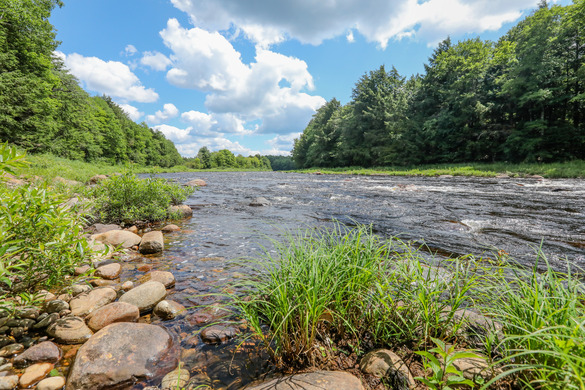
Ton-Ka-Wa Parcel
The Nature Conservancy received over $500,000 from DEC’s WQIP grant program
to conserve properties for source water protection in the Black River
Valley. A portion of the grant has been used to conserve a
property within the town of Ohio to protect Hinckley Reservoir, a
drinking water source for more than 125,000 New Yorkers. Known as the
Ton-Ka-Wa property, the land was conserved
through a conservation easement, allowing the property to remain under
private ownership while being managed to protect clean drinking water. The
conservation easement will be held and stewarded by the Tug Hill Tomorrow
Land Trust.
The Nature
Conservancy analyzed data to identify parcels that either currently, or
following restoration, have the potential to contribute to source water
protection and landscape connectivity. The 768-acre Ton-Ka-Wa parcel was one of the top-rated properties for both.
In addition to protecting clean drinking water, the property will also
connect important habitats between the Tug Hill Plateau and the Adirondack
Park. The Black River drains the western slope of the Adirondack Mountains
and the eastern edge of the Tug Hill Plateau before flowing north and west
and emptying into Lake Ontario. The Black River watershed is mostly
forested and sparsely populated.
The property is
adjacent to West Canada Creek which drains into Hinckley reservoir with
more than 2,500 feet of shoreline. Another 6,500 feet of Conklin Brook is
also on the property. Woody wetlands and mixed forest make up most of the
land cover protected under the easement. The area
along these streams and throughout the property consists of land uses that
act as natural filters for potential pollutants that would otherwise enter
the drinking water source through events such as flooding and stormwater runoff.
The shoreline and land cover will now be protected in perpetuity for source
water protection. Conservation of this property supports New York State’s 30x30 initiative, part of greater
national and international goals of conserving 30 percent of lands and
waters by 2030.
Water Quality
Improvement Project Program
In May, Governor Hochul announced a combined $300 million in climate
resiliency funding available, including at least $215 million for WQIP
projects funded through the State’s Environmental Protection Fund (EPF),
Clean Water Infrastructure Act (CWIA), and the Clean Water, Clean Air and
Green Jobs Environmental Bond Act of 2022. Applications were accepted
through July and DEC is reviewing submissions. Earlier this year, the
State awarded $146 million through the WQIP to support
municipal wastewater treatment upgrades, polluted runoff abatement and
control, land acquisition projects for drinking water protection, salt
storage construction, aquatic connectivity restoration, and marine habitat
restoration. More information on this program is available on the DEC WQIP website.
Additional
Efforts to Protect Drinking Water Resources
DEC and the State Department of Health, in collaboration with the
Departments of Agriculture and Markets and State, created the Drinking
Water Source Protection Program (DWSP2) to assist municipalities with
proactively protecting their drinking water sources. Communities work with
a technical assistance provider, free of charge, to develop and initiate
implementation of their drinking water source protection program. DWSP2
plans protect both public health and water quality of surface and
groundwater across the state. To date, DWSP2 has served nearly 2.5 million
water consumers and evaluated 136 source waters in
New York State. If interested in becoming one of more than 100
municipalities participating in DWSP2, please visit the DWSP2 website to fill out an interest form and
view example plans, factsheets, and past newsletters. For further
questions, reach out to the DWSP2 Team at source.water@dec.ny.gov.
New York's
Commitment to Water Quality
New York State continues to increase its nation-leading investments in
water infrastructure, including more than $2.2 billion in financial
assistance from the Environmental Facilities Corporation (EFC) for
local water infrastructure projects in State Fiscal Year 2024 alone. With
$500 million allocated for clean water infrastructure in the FY24 Enacted
Budget announced by Governor Hochul, New York will have invested a total of
$5.5 billion in water infrastructure between 2017 and this year. The
funding is in addition to other substantial water quality investments,
including the voter-approved $4.2 billion Environmental Bond Act,
which is advancing historic levels of funding to update aging water
infrastructure and protect water quality, strengthen communities' ability
to withstand severe storms and flooding, reduce air pollution and lower
climate-altering emissions, restore habitats, and preserve outdoor spaces
and local farms. Governor Hochul’s 2024 State of the State
initiatives are helping to ensure ongoing coordination with local
governments and ensure communities can leverage these investments. The
Governor increased WIIA grants for wastewater projects from 25 to 50
percent of net eligible project costs for small, disadvantaged communities.
The Governor also expanded EFC’s Community Assistance Teams to help small,
rural, and disadvantaged communities leverage this funding and address
their clean water infrastructure needs. Any community that needs help with its water infrastructure
is encouraged to contact EFC.
|