|
Local Resident Compiles List of ‘101 Fun Facts to
Love About Lewis County and the Tug Hill Region, NY’
Published: October 13, 2024
at 12:00 p.m.
By: Guest Post from Lewis County Resident Calvin Campany
Editor’s Note: This list was
compiled by Lewis County resident Calvin Campany,
who shared his work with linkinglewiscounty.com for publication. Mr. Campany used a variety of public sources to compile the
list, including U.S. Census data, the U.S. Department of Agriculture, the
Lewis County Historical Society and others. The author is responsible for
the information and statistics in this article and all statements made
herein. Enjoy!
101 Fun Facts to Love about Lewis County & The
Tug Hill Region, NY
By: Calvin Company
Trailside
North Country Blog
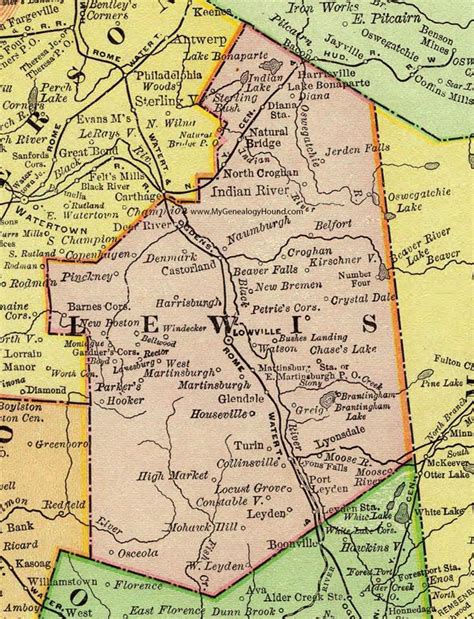
1. Lewis County was
established in 1805 from sections of Oneida County.
2. A best guess on
the origin of the name for the Tug Hill region is that “Tug Hill” was a
frequently used name in the 19th century for many areas reached by horses
or oxen “tugging” a wagon up a long road to get to a high area. H.E.
Krueger in his article “The Lesser Wilderness – Tug Hill” in a 1966-1967
article in The Conservationist speculated that Tug Hill was named by two
early settlers, Isaac Perry and a Mr. Buell when traveling up the hill west
of Turin.
3. Lewis County, New
York, has 1,276.3 square miles of land, while Rhode Island has 1,033.6
square miles. (The LC is 242.7 square miles bigger than RI!)
4. Tug Hill is
larger than the state of Delaware, with 2100 square miles vs Delaware of
1948 square miles.
5. Lewis County is
named after Morgan Lewis, the 3rd Governor of New York, who signed the
Declaration of Independence and fought in both the Revolutionary War and
the War of 1812.
6. The county seat
is Lowville. The town is named after Nicholas Low, an early
landowner, wealthy merchant, and developer. (Despite popular folk
etymology, the name 'Lowville' has nothing to do with its low elevation or
the “lowing” cattle of the many nearby dairy farms.)
7. 164,865 acres of
Lewis County are within the blue line of the Adirondack Park – which is the
largest park in the contiguous United States, covering 6 million acres and
taking up one-fifth of New York State. It's almost as big as Vermont
and more than double the size of Yellowstone and Yosemite National Parks
combined.
8. The Lewis County
Fair, which dates to 1820, is the first free and one of the oldest
continuously running fairs in New York.
9. Archeological
evidence suggests that humans have lived in Lewis County for at least
13,000 years.
10.
Harrisville in Lewis County takes its name from Foskit Harris, who settled there in 1833. Harris
constructed a sawmill and gristmill, harnessing the West Branch of
the Oswegatchie River for power to operate the mills.
11.
More than 200,000 maple trees are tapped each spring,
making Lewis County one of New York’s leading maple syrup producers.
12.
The population density of Lewis County is 21
inhabitants per square mile, while the population density of Manhattan is
72,918 inhabitants per square mile.
13.
An antique Bible from the 1500’s is housed in the
Mennonite Heritage Farm Museum.
14.
Franklin Benjamin Hough, born in Lewis County in
1822, was an American scientist and historian. He was the first chief of
the United States Division of Forestry (the predecessor of the United
States Forest Service) and among the first to call attention to the
depletion of forests in the U.S. and he is sometimes called the
"father of American forestry.”
15.
There are ten Historical Museums located in Lewis
County.
16.
There are eight traffic lights in Lewis County, and
two caution lights.
17.
There are 23 churches in Lewis County.
18.
There are 18 bars and taverns in Lewis County.
19.
Approximately 10,000 years ago, glaciers covered
Lewis County during the last Ice Age, carving out many of its lakes,
valleys, and distinctive landforms. The glaciers may have been almost two
thousand feet thick.
20.
Constable Hall in Lewis County is believed to be the
inspiration for the classic poem T’was
the Night Before Christmas. Poet Clement Moore often visited his
widowed cousin Mary Eliza Constable and her five children during the
Christmas Holidays.
21.
As of the 2020 census, the population of Lewis County
is approximately 26,500 people.
22.
Walter Hunt, an inventor from Lewis County, is
credited with inventing the safety pin and an early sewing machine.
23.
Whetstone Gulf State Park in Lewis County is built in
and around a three-mile-long gorge cut into the eastern edge of the Tug
Hill Plateau. The gorge is one of the most spectacular scenic vistas east
of the Rocky Mountains and is called the Grand Canyon of the East.
24.
The town of Diana is named after the Roman goddess of
the hunt and the moon. It was established in 1830 from part of the town of
Watson.
25.
Hough’s Caves, in Lewis County, was an important spot
on the Underground Railroad. Local abolitionists hid escaping slaves
seeking freedom in Canada at this location before being ferried across the
St. Lawrence River.
26.
In 2015, Copenhagen in Lewis County was the snowiest
place in America, with 21 feet of snowfall recorded.
27.
Snowmobiling Economy: The snowmobile trails bring
significant winter tourism dollars to the county. In Lewis County,
snowmobile visitors raise nearly a half million in tax dollars annually.
28.
The Maple Ridge Wind Farm in Lewis County is one of
the largest in the eastern U.S.
29.
Florence Augusta Merriam Bailey (August 8, 1863
– September 22, 1948) was an American ornithologist and nature writer. She
was born in Locust Grove, New York. Between 1890 and 1939, she
published a series of field guides on North American bird life. These
guides were often written with amateur birdwatchers in mind, leading to the
popularity of the birding movement.
30.
The famous Lewis County delicacy, Croghan Bologna,
originates from the village of Croghan.
31.
There are 35,254 unique snowmobile users of the Tug Hill
Trails each year.
32.
In 1815, Joseph Bonaparte, the elder brother
of Napoleon I and former King of Spain, purchased a tract of
land from James LeRay. Part of it became the town of Diana in Lewis
County.
33.
The highest point in Lewis County is Gomer Hill, a
2,115-foot-tall mountain in the town of Turin.
34.
Lewis County, NY has 35 spots identified as National
Register of Historic Places.
35.
Franklin Benjamin Hough, born in Martinsburg in 1822,
discovered a mineral that would bear his name, Houghite,
a local variety of hydrotalcite.
36.
There are 7 Lewis Counties in the United States. New
York, Idaho, Kentucky, Missouri, Tennessee, Washington, and West Virginia.
There is also a Lewis & Clark County in Montana and a St. Louis County
in Missouri.
37.
“The enemy of my enemy is my friend.” In 1807, the
inhabitants of Mungers Mills in Lewis County, to indicate their resentment
against the British and sympathy for the citizens of the defenseless city
of Copenhagen, Denmark, then under siege by the British, elected to change
the name of their bustling little community to Copenhagen.
38.
Kings Falls, in the Town of Denmark, is named after
ex-King Joseph Bonaparte’s affection for the beautiful setting of the
40-foot cascade on the Deer River.
39.
Montague is the second smallest town in the state,
with a population of 78.
40.
On April 18, 1966, the village of Copenhagen, NY, was
honored by a visit from the Lord Mayor, Urban Hansen, mayor of Copenhagen,
Denmark.
41.
The Black River, Black Creek, and Oswegatchie (“The
place of the black waters” in the local Native American language) may stem
from the natural tannic acid from the hemlock trees that darken the water
in many places.
42.
Though more than 50 miles from Lake Ontario and 225
miles from the Atlantic Ocean, Port Leyden was named because it was an
essential stop for shipping on the Black River Canal.
43.
Osceola was named after the great Native American
Seminole Warrior Osceola.
44.
Lyons Falls, originally known as High Falls, became
known as Lyon (later Lyons) Falls in Honor of the Caleb Lyon family.
45.
An unusual three-way bridge was built in Lyons Falls
to span the confluence of the Moose and Black Rivers. It was featured in
Ripley’s Believe It or Not. Later, in the early 1960s, it was replaced by
two separate bridges.
46.
The town of Pickney was named by the state
legislature to honor the Revolutionary War general and statesman Thomas
Pinckney of South Carolina.
47.
Croghan is home to the International Maple Museum and
Hall of Fame in Lewis County.
48.
Matthew Bush, of Croghan NY is a top ranked US ax-man and team captain of the US National Ax Team, has
held world titles in many Lumberjack Championships, and is the only
American ever to win ESPN’s Great Outdoor Games Endurance Event.
49.
Lewis County is home to a beloved cryptid, the river
monster Lyonesse, who lives in the Black River in Lyons Falls.
50.
There are more cows than people. Lewis County has
almost two cows per person – with an estimated cattle and calf population
of 51,000 bovines.
51.
The average price of an owner-occupied home in Lewis
County is $146,000.
52.
The average median household income in Lewis County
is $64,401.
53.
The annual per capita income of Lewis County is
$31,127 per resident.
54.
The average age of someone who lives in Lewis County
is 42.
55.
There were 1,122 farmers on 625 farms counted in
Lewis County during the 2017 Agriculture Census.
56.
$113,927,00 in milk sales came from Lewis County in
2017.
57.
182,000 acres are used as farmland in Lewis County.
58.
There are 36 State Forests in Lewis County
59.
In 1877, Copenhagen resident Joseph Butlin came upon a mammoth tusk lodged five feet amid a
swampy muck in Lewis County, proving that this large prehistoric animal
once walked the land.
60.
Mary Montague Pierrepont, the daughter of a former
landowner in Lewis County, inspired the town’s name. It was created from
the larger town of West Turin in 1850.
61.
Fifteen square miles of Lewis County are covered by bodies
of freshwater.
62.
The Town of Greig was initially named “Brantingham”
after Philadelphia merchant Thomas Hopper Brantingham. Unfortunately,
Brantingham turned out to be a bit of a scoundrel; he defaulted on the
purchase price for the Tract, wound up in prison, and, after litigation
with Alexander Hamilton, ended up having his interests foreclosed and
title lost. The town elders decided to have its name changed from
Brantingham to Greig. It was renamed in honor of John Greig, a lawyer in
the Finger Lakes region of New York who ultimately ended up with title to
substantial holdings in the northern part of the original Brantingham
Tract.
63.
In 1800, part of the township of Mexico and part of
Oneida County became a new township, Turin. The township stretched from the
Black River to Tug Hill and included, at that time, the townships of Turin,
West Turin, Lewis, Highmarket, Osceola, Montague,
and Martinsburg.
64.
The Town of Turin took its name from Turin, the
famous and beautiful capital city of the Kingdom of Sardinia (now part of
Italy).
65.
Benjamin Doud settled in Turin in 1797. His great,
great granddaughter was Mame Doud Eisenhower, wife of President Eisenhower.
66.
St. Stephen’s in Croghan, NY, was once a thriving
religious institution with a school, a convent for nuns, and a monastery
where members of the Franciscan order of Friars Minor received
training. Fr. Leo Heinrichs, who has been declared a “Servant of God”
by the Roman Catholic church due to his martyrdom in Colorado, served as
pastor of St. Stephens in the early 1900’s.
67.
42% of Lewis County is under forest preservation by
the state of New York. That includes easements and all State Forests,
Preserves, Wilderness areas, Wildlife Management Areas, and boat launches.
68.
The Black River Canal was built in 1828 to
connect the Erie Canal to the Black River. Along its 35-mile
length, the canal had 109 locks, connecting Boonville to Carthage through
Lewis County. Several of the canal's former locks remain visible
along New York State Route 12 near Port Leyden.
69.
With over 650 employees, Lewis County General
Hospital is the largest employer in Lewis County.
70.
Clinton Hart Merriam, born in 1855, was an
American zoologist, naturalist, and physician. He was commonly known
as the "father of mammalogy," a branch of zoology referring to
the study of mammals. Although Merriam was born in New York City, his
family home and place of boyhood was "Locust Grove," a homestead
in Lewis County, New York.
71.
A small stone marker marks the intersection of Lewis,
Jefferson, and St. Lawrence County at 16 Byrns Rd, Gouverneur, NY 13642.
72.
Lewis County has approximately the same population as
the small city of Elmira, NY, while there are 5.5 times as many inhabitants
within Syracuse’s city limits as all of Lewis County.
73.
There are nine native species of frog and one native
species of toad that live in Lewis County, NY.
74.
Theodore B. Basselin was an
American lumber magnate from Croghan, New York, best remembered for an
endowed scholarship he created at the Theological College of
the Catholic University of America. The Basselin
scholarship has funded the philosophical education of many notable American
churchmen. He served on the Forest Commission for six years. During his
tenure, significant progress was made in forest fire prevention, protecting
state lands, and establishing the Adirondack Park.
75.
Lewis County owns approximately 4,200 acres of land and
maintains 44 miles of multi-use trails.
76.
Lewis Co is home to Singing Waters Park, which is
105.7 acres which features waterfalls, hiking trails, day-use areas, and
ten tent campsites.
77.
Lewis County has fossils from the Ordovician Age, 485
to 444 million years ago. At this time, trilobites roamed the sea that
covered most of North America.
78.
Lowville Academy, founded in 1808, is one of the
oldest and longest continually operating schools in New York State.
79.
Lewis County is home to eight snake and three turtle
species.
80.
Lewis County is home to 9 species of bats.
81.
Charlie and the Chocolate Factory child
actor Peter Ostrum (born November 1957) settled in Lewis
County to practice veterinary medicine.
82.
The Blizzard of ’77 saw well over 100 inches of snow,
a wind chill factor that ranged from -35 to -47 degrees, 30-foot-high
drifts, and 53-mile-and-hour wind gusts. Scores of communities were
isolated and cut off by blocked roads and travel bans, and Lewis County was
under a state of emergency declaration.
83.
The most haunted location in Lewis County is thought
to be Martinsburg’s Greystone Manor, whose paranormal activity was
investigated by Syracuse’s Central New York Ghost Hunters.
84.
Throughout Lewis County’s fields and forests, you can
see large boulders known as glacial erratics,
which can be found scattered across the region today. These large stones
were left behind as glaciers retreated from our area 10,000 years ago.
85.
On a night in 1954, after a night of drinking to
drown her sorrows, Anna Joan Machowski was decapitated in a fatal car crash
in the town of Montague. Since then, it is said that her spirit has walked
along Sears Pond Road on moonless nights, looking for her missing head.
Lewis County locals call her Tug Hill Anne.
86.
Sarah E. Simonet, the first woman graduate of Albany
College of Pharmacy and Health Sciences, was born in 1854 in Schoharie
County, New York; she was the daughter of Irish immigrants and lived in
Croghan, NY, in Lewis County. She and her husband owned a general store,
and not long after Sarah’s graduation, they added a pharmacy. Two years
later, she graduated from the University of Buffalo as a physician. Simonet
went on to open offices in Croghan and Utica and was held in high esteem by
Croghan, which now has a historical marker that stands in her honor. She
combined the practice of pharmacy with the practice of medicine. She was
dedicated entirely to caring for a medically underserved population.
87.
Eastern Lewis County is part of the Adirondack
Mountains, one of the oldest mountain ranges in the world. Its rocks date
back over a billion years.
88.
About 2,500 white-tailed deer are harvested in
Lewis County each year.
89.
The village of Castorland, NY, means "Land of
the Beaver.” The name stems from a colony of refugees from the French
Revolution, established in 1792 to provide a new home away from the
violence in France. Castorland was meant to be a utopian community for
French emigres fleeing the Reign of Terror following the French Revolution.
Ironically, it was Giardiasis, or “beaver fever,” in addition to the harsh
winters that had driven many of the fleeing aristocrats seeking asylum
away.
90.
In 1862, William Appleton Jr. stumbled across the
Journal of Castorland in a Paris bookstand while visiting France. It was
the only remaining copy of the detailed record kept by two Frenchmen, Simon
Desjardins and Peter Pharoux, of the exploration
and failed settlement of this part of Lewis County by French aristocrats.
This history would otherwise have been lost to the passage of time.
91.
In 2024, Lewis County was in the path of totality
during a total solar eclipse. The next time an eclipse occurs in Lewis
County will be in 2079.
92.
There are 31 man-made dams on Lewis County Rivers.
Eighteen are for hydroelectric production, and the rest are for water
supply, recreation, or other purposes.
93.
There are over 100 named waterfalls, both natural and
man-made, in Lewis County, NY. (*see “Bobbies Waterfalls.com”)
94.
Lewis County has eight peaks over 1000 feet in
height.
95.
On Sept. 20, 2014, Philadelphia Cream Cheese
broke the GUINNESS WORLD RECORDS achievement for creating the World's
Largest Cheesecake. The cake was unveiled at Lowville, N.Y.’s
9th Annual Cream Cheese Festival. However, after losing this title to
a Russian company’s larger cheesecake in 2017, Lowville unveiled an ever
larger, world record claiming cheesecake on September 21, 2024, solidifying
Lewis County’s dominance in cheese making abilities.
96.
Tug Hill is not exactly a hill, nor is it a plateau.
It is a cuesta (an asymmetric ridge with a gentle slope on one side, and a
steep slope on the other) since it is composed of sedimentary rocks that
tip up on one side.
97.
The Tug Hill town of Montague in Lewis
County recorded the unofficial New York State 24-hour snowfall record
of 77 inches (6.4 ft; 2.0 m) in January 1997.
98.
Hooker (a hamlet in the town of
Montague) holds the state record for snowfall in a single season, after
accumulating 466.9 inches (38.91 ft; 11.86 m) of snow during the
winter of 1976–1977.
99.
General Walter Martin was the founder
of Martinsburg, New York. He was born in Sturbridge,
Massachusetts in 1764. He established the village of Martinsburg in
1803 on an 8000-acre tract he had purchased in Oneida County in
northern New York. In 1805 when Lewis County was formed from
part of Oneida County, Martin influenced the selection of Martinsburg as
the county seat by donating land and money for a courthouse. Martin
constructed Greystone Manor, a large stone mansion in Martinsburg
100.
The greater Tug Hill region is defined in New York
State law as encompassing the 41 towns in four counties,
with a total area of approximately 2,100 square miles.
101.
The term “North Country” as a description of our area
became popularized a 1900 novel by Irving Bacheller Eben Holden: A
Tale of the North Country is. It was a successful book at the time
of its release, among the top 10 bestselling books in the United
States in both 1900 and 1901 with over a million copies sold. The book
is set in the North Country region of New York.
|