|
DEC Reminds Property Owners to Prioritize Home
Heating Safety This Winter by Inspecting Oil Fuel Tanks and Equipment for
Leaks and Spills
Published: October 21, 2024
at 10:45 a.m.
By: Press Release
from NYS DEC
DEC Reminds Property Owners to Prioritize Home
Heating Safety This Winter by Inspecting Oil Fuel Tanks and Equipment for
Leaks and Spills
Property Owners Advised to Put Safety First and
Utilize Assistance Program Opportunities
The New York
State Department of Environmental Conservation (DEC) advises property
owners to prioritize safety when preparing for home heating needs this fall
and winter. DEC reminded property owners that connecting occupied buildings
to wells producing natural gas is dangerous and potentially deadly.
DEC also encouraged property owners to inspect fuel storage tanks for
potential leaks or spills prior to receiving shipments of fuel oil for the
upcoming heating season. In addition, DEC urged residents to take steps now
to utilize programs designed to save consumers energy and money.
“Planning ahead
for the winter season will help save New Yorkers time, money, and
potential headaches later on when it comes to home heating,” DEC
Interim Commissioner Sean Mahar said. “Annual inspections and other
simple precautions can prevent leaks and spills and ensure people,
property, and the environment are protected.”
Natural Gas
Safety
Natural gas produced by a gas or oil well is odorless and difficult or
impossible for a person to detect. While the primary component of
natural gas is methane, gases like propane and butane may also be present
in addition to water, because the gas is raw and untreated. This may result
in improper and erratic combustion in appliances. The risk of an
explosion due to natural gas build-up in a home is substantially greater
when that gas is not provided by a utility.
If a home-use
well is connected to a house or other structure:
- Contact a plumber licensed to work on gas
lines and have the fuel source switched to utility natural gas or
consider another fuel or heating appliance;
- Natural gas directly from a well is odorless
and colorless, meaning it may build up to explosive levels without
detection. Install methane detection alarms in any closed space where
methane may accumulate;
- Commercial gas suppliers always add the
odorant mercaptan to natural gas before it is delivered for use.
Consider adding mercaptan to natural gas from a home use well so it
can be more easily detected; and
- Contact DEC if the well is not registered in
DEC’s database. Owning and operating an oil or gas well comes with
regulatory responsibilities to protect the environment. New York is
actively plugging oil and gas wells throughout the state and home
wells may be eligible for the State’s program.
For questions and
additional information about home-use wells, contact DEC at (518) 402-8056
or oilgas@dec.ny.gov.
Also, visit DEC’s website for details.
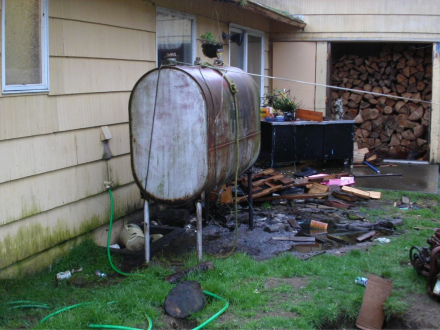
NYSDEC. Oil spill from a
home heating tank.
Fuel Oil Safety
DEC also reminds home and property owners to inspect heating fuel oil
storage tanks for leaks or spills before ordering and receiving fuel oil.
Annual
inspections can prevent leaks and spills and protect property, public
health, and the environment. Homeowners are advised to look for the
following concerns and contact their fuel oil service provider if they see
any of the items from the lists below.
For above-ground
heating fuel oils storage tanks, look for:
- Bent, rusty, or wobbly tank legs or tank
located on an unstable foundation;
- Signs of rust, weeps, wet spots, or many
dents on the tank's surface;
- Drips or any signs of leaks around the oil
filter or valves;
- Fuel oil lines not covered in a protective
casing - even if under concrete;
- Overhanging eaves where snow and ice could
fall onto the tank;
- Stains on the ground or strong oil odor
around the tank;
- Browning, dying, or loss of vegetation around
the tank;
- Silent overfill whistle while tank is being
filled - ask fuel delivery person;
- Fully or partially blocked tank vent from
snow, ice, or insect nests;
- Signs of spills around fill pipe or vent pipe;
- Improperly sized vent pipes - ask fuel
delivery person; and
- Cracked, stuck, or frozen fuel level gauges
or signs of fuel around them.
For underground
heating fuel oils storage tanks, look for:
- Water in the tank - ask fuel
delivery person to check;
- Oil or oil sheen in your basement sump or
French drain;
- Silent overfill whistle while tank is being
filled - ask fuel delivery person;
- Fully or partially blocked tank vent from
snow, ice, or insect nests;
- Signs of spills around fill pipe or vent pipe;
- Well water has strange tastes or smells;
- Complaints from neighbors of
fuel oil smells; and
- Using more than normal amount
of fuel.
Fuel oil spills
or leaks should be reported to the DEC Spills Hotline at 1-800-457-7362.
For more information on home heating oil tank stewardship, visit the Underground Heating Oil Tanks: A Homeowner's Guide webpage
on DEC's website.
Help for
Homeowners
New Yorkers can take the following steps in their homes to help improve
safety and protect against higher energy costs, including:
DEC is interested
in reaching interested landowners to participate in a voluntary oil and gas
well plugging program using more than $50 million in state and federal funding.
Landowners who
suspect an orphaned well may be located on their property should review the
information on DEC’s website: Finding and Identifying Oil and Gas Wells. Landowners
will also find contact information for DEC’s regional offices to report the
well for placement on DEC’s well plugging priority list.
|