|
Sheriff’s Office Brings ‘Project Lifesaver’ to Lewis
County to Help Assist in Searches for Vulnerable Individuals Prone to
Wandering
Published: March 24, 2022 at
12:30 p.m.
By: Nick
Altmire
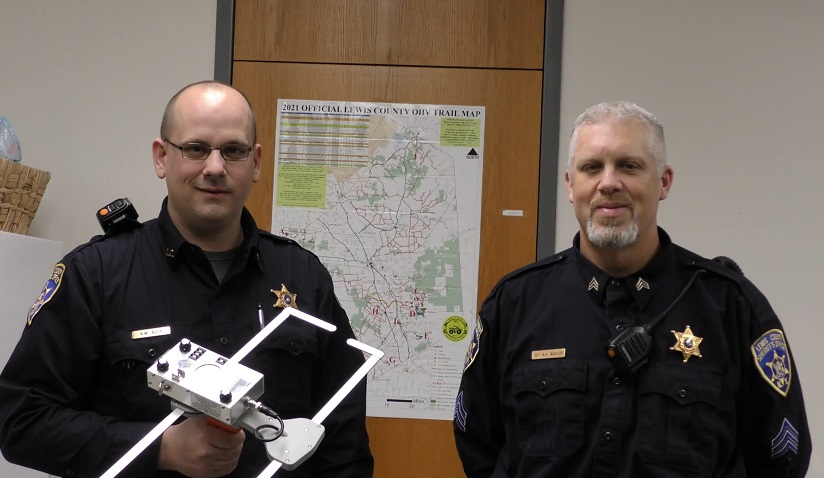
Deputy Keith Bush (L) and Sgt. Noah Warcup (R) will oversee Project Lifesaver® at the Lewis
County Sheriff’s Office
Lowville, NY- A new tool to assist
in the search for vulnerable individuals prone to wandering has arrived at
the Lewis County Sheriff’s office. After years of consideration by the
county legislative board, the Sheriff’s office was finally approved
recently to implement Project Lifesaver®, an international search and
rescue program operated by local agencies.
The program is strategically
designed for “at risk” individuals who are prone to the life-threatening
behavior of wandering, according to its website, with the primary mission of
Project Lifesaver® being to provide timely response to save lives and
reduce potential injury for adults and children with the propensity to
wander due to a cognitive condition.
Lewis County is
one of the last counties in New York state to implement the project,
according to Lewis County 911 Operations Coordinator Cheryl LaLonde.
Once approval to
the join the program was received no time was wasted in getting the project
implemented. Deputy Keith Bush and Sgt. Noah Warcup
immediately volunteered to oversee and manage the project in Lewis County.
Both attended the required training and in turn trained additional staff
and deputies at the Sheriff’s office on how to use the equipment.
How it Works
Project
Lifesaver® provides law enforcement and caregivers with a program designed
to protect, and when necessary, quickly locate individuals with cognitive
disorders who are prone to the life-threatening behavior of wandering.
The program is
run at the municipal level by public safety agencies. Once an agency
decides to implement the program, Project Lifesaver International provides
them with the necessary technologies, equipment, and training. The training,
according to the project website, includes the use of the equipment, the
implementation of the strategic methods specifically designed for the
program, in addition to community policing courses that provide a basic
understanding of cognitive conditions to better comprehend the behaviors of
an individual with said condition. Also included during training is the use
of the PLS Database, which is a useful resource provided to member agencies
at no cost. Completion of training is required for certification. Once an
agency has become certified, they may begin acquiring clients for their
local program.
The method relies
on proven radio technology and specially trained search and rescue teams. Citizens
enrolled in Project Lifesaver® wear a small transmitter on the wrist or
ankle that emits an individualized frequency signal. If an enrolled client
goes missing, the caregiver notifies their local Project Lifesaver agency,
and a trained emergency team responds to the wanderer’s area. The first
responders will then use the client’s individualized frequency to locate
the position of the individual.
“The project has
a 100 percent success rate in locating vulnerable individuals, with an
average time of under an hour,” Sgt. Warcup said.
The transmitter allows the responders to pinpoint a general direction of
the missing individual much quicker, saving time when direction of travel
and other factors are unknown.
Time can be
crucial in these situations, with the search time for an individual not
enrolled in the project averaging over 9 hours.
To start the
project, money from the 911 center’s Public Safety Answering Points (PSAP)
funds were used. PSAP funds are the 911 surcharges customers pay on their
telephone bills, money that is then allocated to the county by the state
for use in emergency services programs and technology.
“Anytime a human
life is involved, you can’t put a price on it,” Lewis County Sheriff Mike Carpinelli said. “It doesn’t matter the cost, we have to find that person. Every tool that we have to assist with that helps.”
The initial
investment includes three receiver units and ten transmitter kits for the
first group of individuals who enroll in Lewis County. Some of the equipment
and the training for the program was donated by the New York State
Department of Corrections. The plan is to keep the project funded through
donations or with county money through a line item in the budget for the
program.
“This is a really
good program,” Ms. Lalonde said. “I’m really excited that we are able to
bring this to Lewis County.”
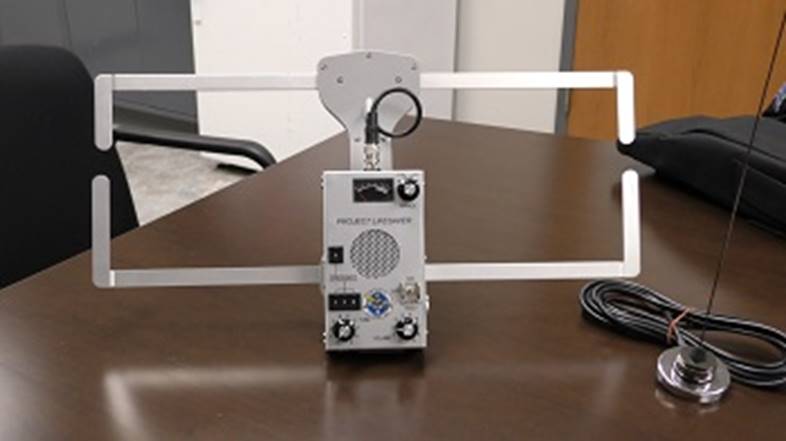
Lewis County has
purchased three receiver units for Project Lifesaver®, one for the north
car, one for the south car and one to be kept at the Public Safety Building
in Lowville
Who is Eligible
to Enroll in Project Lifesaver®?
The program is
focused on any individual with a cognitive disorder that would lead to the
likelihood of wandering. This includes individuals with Alzheimer’s
disease, autistic children and adults, individuals suffering from a
traumatic brain injury, and individuals with Downs Syndrome.
 Enrollment in the program starts with the
caregiver giving the Lewis County Sheriff’s office a call at 315-376-3511.
Deputy Bush and/or Sgt. Warcup will then meet
with the caregiver to ensure the program is a good fit. Once an individual
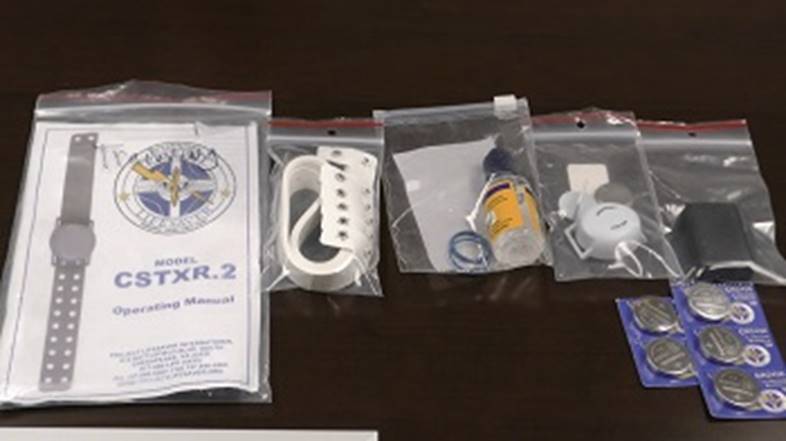
is determined to have met the criteria for the program, the caregiver is
then provided with a bracelet and transmitter (pictured) for their loved
one that emits an individualized frequency signal. There will be no cost to
the individual, with all expenses covered by the Sheriff’s office through
the program. Enrollment in the program starts with the
caregiver giving the Lewis County Sheriff’s office a call at 315-376-3511.
Deputy Bush and/or Sgt. Warcup will then meet
with the caregiver to ensure the program is a good fit. Once an individual
is determined to have met the criteria for the program, the caregiver is
then provided with a bracelet and transmitter (pictured) for their loved
one that emits an individualized frequency signal. There will be no cost to
the individual, with all expenses covered by the Sheriff’s office through
the program.
“Signing an
individual up for the program is a fairly simple process,” Deputy Bush
said, adding that once their team is contacted an individual can be up and
running in the program within a day or two.
Caregivers can
also contact the Lewis County Office for the Aging at 315-376-5313 for
information about and enrollment into the program.
“I’m happy to see
this come to fruition,” Sheriff Carpinelli said.
“This is a perfect example of everyone here at the Sheriff’s office coming
together to accomplish the mission at hand. I’m very proud to be the
Sheriff for a group of people like that. Although I feel there is a great
need in our community for a program like this, hopefully we never need to
use it.”
For more
information on Project Lifesaver®, visit their website here. To learn more
about the program locally or to enroll an individual, contact the Lewis
County Sheriff’s Office at 315-376-3511 or the Lewis County Office for the
Aging at 315-376-5313. The program is ready to go locally and will begin
enrolling clients immediately.
|