Overall Harvest Declined;
Catskills Harvest Rate Remains Highest
New York bear hunters took
1,346 black bears during the 2021 hunting seasons, the New York State
Department of Environmental Conservation (DEC) announced today.
"Every year, New York's
bear hunters provide DEC wildlife managers with valuable information to
help guide future management decisions," said DEC Commissioner Basil Seggos. "Although they
aren't always successful, thousands of dedicated hunters venturing afield
each year help keep populations at desired levels, maintaining healthy
bear populations in the state."
Hunters took an estimated 403
bears in the Northern Zone and 943 bears in the Southern Zone. This
represents roughly 30 percent fewer bears taken in the north and 20
percent fewer taken in the south than in 2020, but only about 10 percent
fewer than the five-year average harvest in each zone.
Throughout the state, there
is generally an alternating pattern of high and low bear harvest from
year to year, which is influenced by fluctuating patterns in cub
production and food availability. Because bear harvest was greater than
average in 2020, and because natural foods for bears were abundant this
fall, biologists expected the bear harvest to decline slightly in 2021.
However, warm weather through much of the early season likely coupled
with the abundant food to reduce bear movements and thereby reduced bear
harvest more than expected.
Despite an overall lower
harvest, the Catskill region continues to produce the greatest bear
harvest densities, and in Wildlife Management Units (WMU) 3A, 3C, 3K, 3P,
4R, and 4W, hunters took more than 10 bears per 100 square miles. Bear
management objectives are to maintain stable bear populations through
most of New York and reduce bear abundance in the central and southern
Catskills.
|
Estimated
Bear Harvest Totals
|
|
|
2021
Total
|
2020
Total
|
Recent
5-Year Average (2016-2020)
|
|
Northern
Zone
|
403
|
571
|
457
|
|
Early
|
NA*
|
298
|
188
|
|
Bow
|
12
|
47
|
39
|
|
Muzzleloader
|
12
|
64
|
47
|
|
Regular
|
376
|
161
|
182
|
|
Youth
|
3
|
1
|
0
|
|
Southern
Zone
|
943
|
1,152
|
1,039
|
|
Early
|
100
|
366
|
221
|
|
Bow
|
322
|
417
|
354
|
|
Muzzleloader
|
23
|
3
|
12
|
|
Regular
|
490
|
356
|
442
|
|
Youth
|
8
|
10
|
9
|
|
Statewide
|
1,346
|
1,723
|
1,496
|
*In 2021, DEC simplified the
bear hunting seasons in the Adirondack WMUs by expanding the regular
season to incorporate the early, bow, and muzzleloader season. Bow and
muzzleloader season continued in the other Northern Zone WMUs.
Notable
Numbers
·
24.2: the
number of bears harvested per 100 square miles in WMU 3K (southern
Sullivan County and a portion of Orange County), which had the greatest
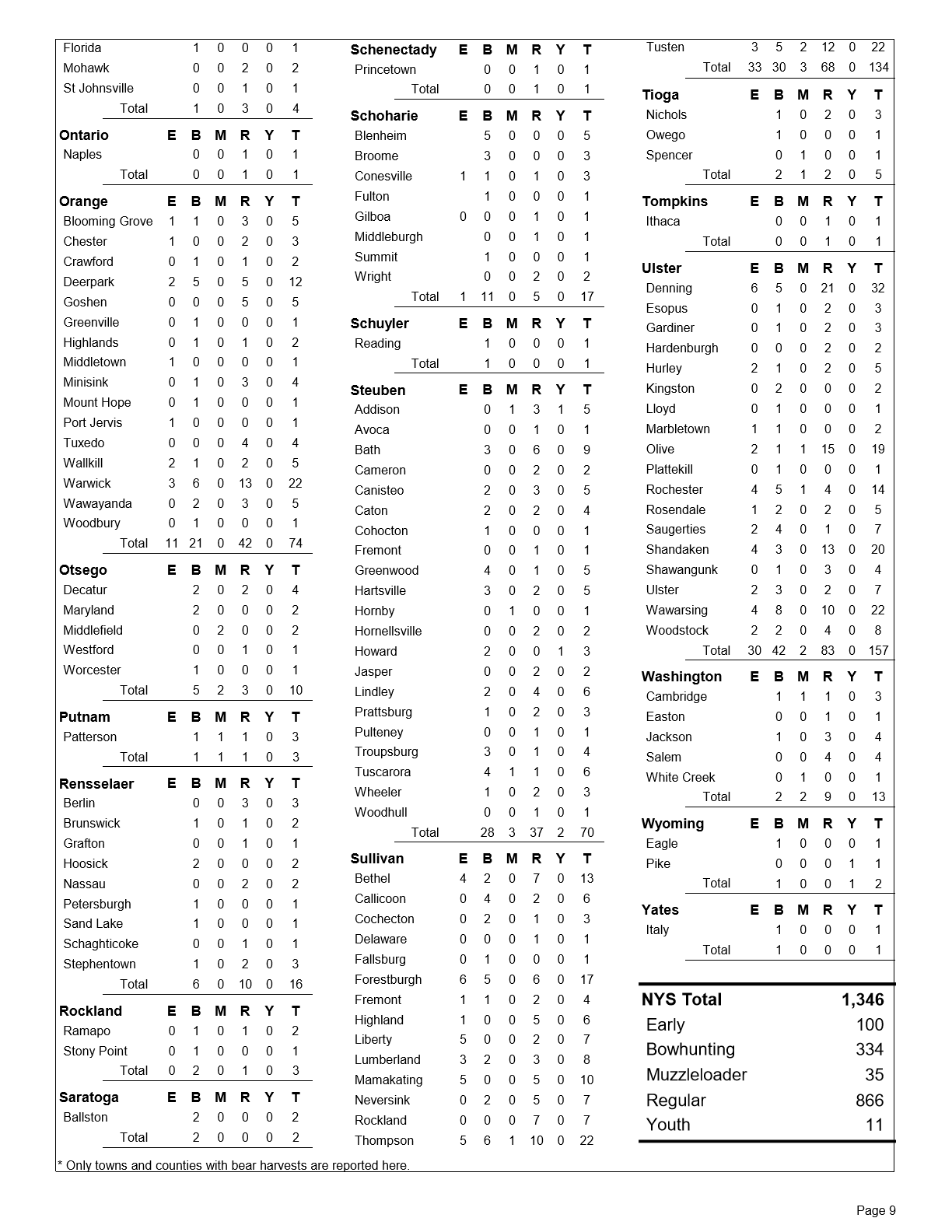
bear harvest density of any unit. The town of Tusten
in Sullivan County yielded 4.6 bears for every 10 square miles.
·
143: the
greatest number of bears reported taken on any one day. This occurred on
the Nov. 20 opening day of the regular bear season in the Southern Zone.
·
560 pounds: the
heaviest dressed-weight bear reported to DEC in 2021, taken in the town
of Hunter, Greene County, WMU 3A. Of the top 25 heaviest bears, five came
from St. Lawrence County and five from Ulster County. Scaled weights of
dressed bears were submitted for 28 percent of bears taken in 2021.
·
10: the
number of tagged bears reported in the 2021 harvest. These include two
bears originally tagged in Pennsylvania.
·
637: the
number of hunter-killed bears from which DEC collected teeth for age
analysis in 2021.
·
14 percent: the
proportion of bears taken by non-resident hunters. Successful
non-resident bear hunters hailed from 20 states and one territory.
Black bear harvest data are
gathered from two main sources: harvest reports required of all
successful bear hunters; and the physical examination of more than 300
bears by DEC staff and cooperating taxidermists. Harvest estimates are
made by cross-referencing these two data sources and determining the rate
at which hunters report bear harvests in each zone.
In 2021, 84 percent of
successful bear hunters reported their harvest. Hunters who reported
their harvest and submitted a tooth for age analysis receive a 2021
Black Bear Management Coordinator Patch and will be
informed this fall of the age of their bear.
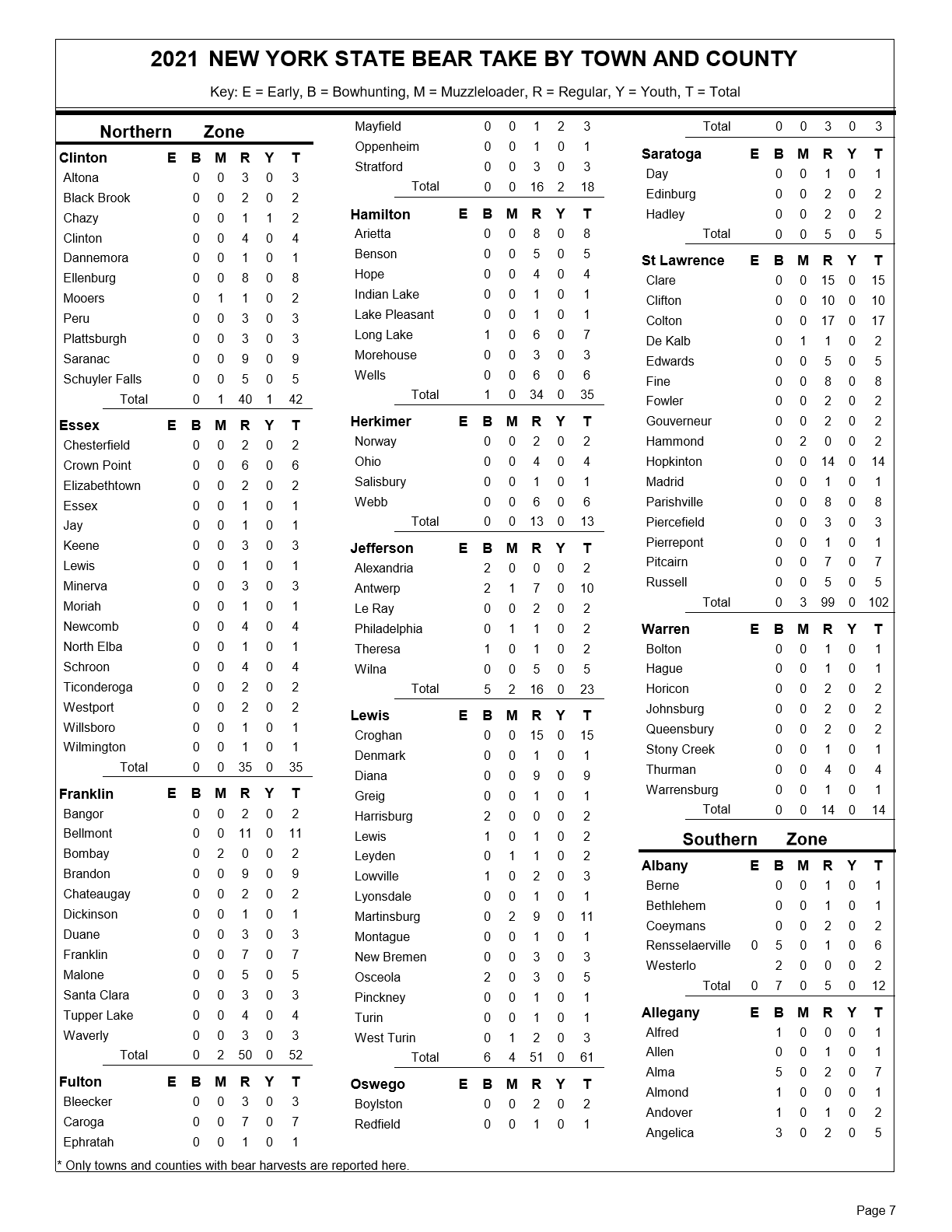
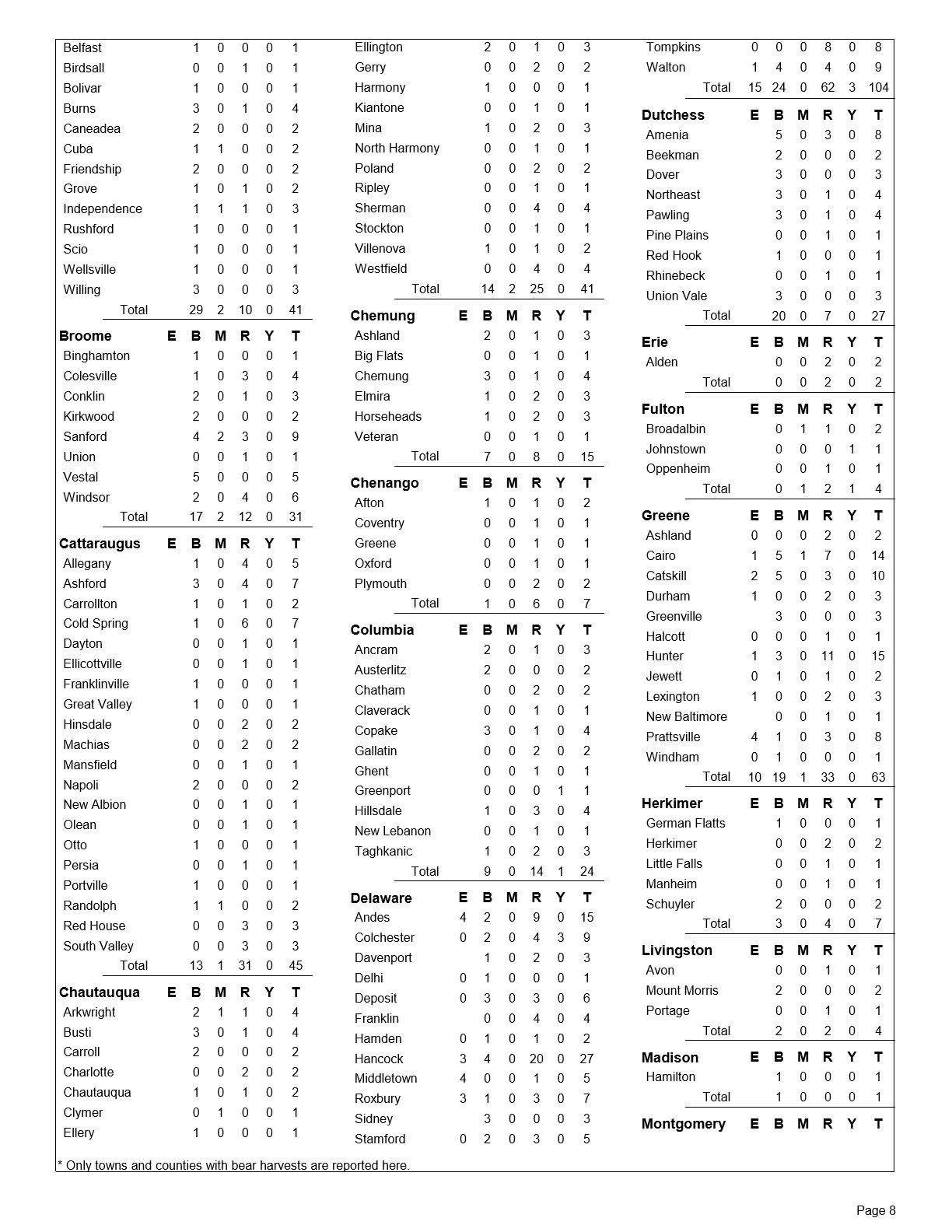
DEC's 2021
Bear Harvest Summary report and past harvest summaries,
including tables, charts, and maps detailing New York State deer harvest,
are available on DEC's website.
|