|
FEMA and FCC to Conduct Nationwide Emergency Alert
Test August 11
Published: August 08, 2021
at 05:45 p.m.
By: Press Release from Federal Emergency Management
Agency (FEMA)
FEMA and FCC Plan Nationwide Emergency Alert Test for
Aug. 11
Test Messages Will be Sent to TVs and Radios Along
with Select Cell Phones That Have Opted-in to Receive Test Messages
 WASHINGTON – FEMA, in
coordination with the Federal Communications Commission, will conduct
a nationwide test of
the Emergency
Alert System (EAS) and Wireless
Emergency Alerts (WEA) this summer.
The national test
will consist of two portions, testing WEA and EAS capabilities. Both tests
will begin at 2:20 p.m. ET on Wednesday, Aug. 11.
The Wireless
Emergency Alert portion of the test will be directed only to consumer cell
phones where the subscriber has opted-in to receive test messages. This
will be the second nationwide WEA test, but the first nationwide WEA test
on a consumer opt-in basis. The test message will display in either English
or in Spanish, depending on the language settings of the wireless handset.
The Emergency
Alert System portion of the test will be sent to radios and televisions.
This will be the sixth nationwide EAS test.
FEMA and the FCC
are coordinating with EAS participants, wireless providers, emergency
managers and other stakeholders in preparation for this national test
to minimize confusion and to maximize the public safety value of the test.
The test is intended to ensure public safety officials have the methods and
systems that will deliver urgent alerts and warnings to the public in times
of an emergency or disaster.
Major
information about the test includes:
- The purpose of the Aug. 11 test is to ensure
that the EAS and WEA systems continue to be effective means of warning
the public about emergencies, particularly those on the national
level. Periodic testing of public alert and warning systems helps to
assess the operational readiness of alerting infrastructure and to
identify any needed technological and administrative improvements.
- The WEA portion of the test will be initiated
using FEMA’s
Integrated Public Alert and Warning System (IPAWS), a centralized
internet-based system administered by FEMA that enables authorities to
send authenticated emergency messages to the public through multiple
communications networks. The WEA test will be administered via a code
that alerts only phones that have opted in to receive WEA test
messages. The EAS portion of the test will be initiated using
FEMA-designated Primary Entry Point stations.
- In case the Aug. 11 test is canceled due to
widespread severe weather or other significant events, a back-up
testing date is scheduled for Aug. 25.
Anyone who has
opted in to receive test messages on their wireless phone will receive the
message only once. The following can be expected from the nationwide test:
- Beginning at 2:20 p.m. ET, cell towers will
broadcast the test for approximately 30 minutes. During this time,
WEA-compatible wireless phones where the subscriber has opted-in to
receive test messages, that are switched on, within range of an active
cell tower and whose wireless provider participates in WEA, should be
capable of receiving the test message. Wireless phones should receive
the message only once.
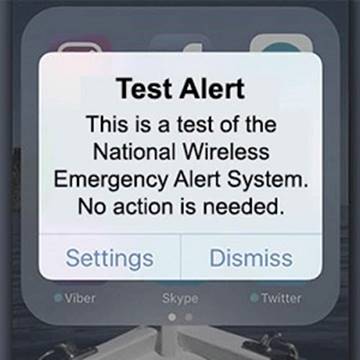
- For consumers who have opted in to receive
WEA test messages, the message that appears on their phones will read:
“THIS IS A TEST of the National Wireless Emergency Alert System. No
action is needed.”
- Opt-in phones with the main menu set to
Spanish will display: “ESTA ES UNA PRUEBA del Sistema Nacional de Alerta de Emergencia. No
se necesita acción.”
- Launched in 2012, WEA is a tool for
authorized government agencies to reach the American public during
times of national emergency. It is used locally to warn the public
about dangerous weather, missing children, and other critical
situations through alerts on cell phones.
- Alerts are created and sent by authorized
federal, state, local, tribal and territorial
government agencies through IPAWS to participating wireless providers,
which deliver the alerts to compatible handsets in geo-targeted areas.
- To help ensure that these alerts are
accessible to the entire public, including people with disabilities,
the alerts are accompanied by a unique tone and vibration. The test
handling code will allow FEMA to test this capability while limiting
test messages to those phones that have opted in to receive test
messages.
- The EAS portion of the test is scheduled to
last approximately one minute and will be conducted with the
participation of radio and television broadcasters, cable systems,
satellite radio and television providers and wireline video
providers (EAS participants).
Other important
information about the EAS test:
- The test message will be similar
to the regular monthly EAS test messages with which the public
is familiar. It will state: “THIS IS A TEST of the National Emergency
Alert System. This system was developed by broadcast and cable
operators in voluntary cooperation with the Federal Emergency
Management Agency, the Federal Communications Commission, and local
authorities to keep you informed in the event of an emergency. If this
had been an actual emergency an official message would have followed
the tone alert you heard at the start of this message. No action is
required.”
- Emergency alerts are created and sent by
authorized federal, state, local, tribal and
territorial government agencies. EAS participants receive the alerts
through IPAWS or through local “over-the-air” monitoring sources. EAS
participants then disseminate the emergency alerts to affected
communities
###
Background: In
2007, FEMA began modernizing the nation’s public alert and warning system
by integrating new technologies into the existing alert systems. The
new system, known as the Integrated Public Alert and Warning System (IPAWS)
became operational in 2011. Today, IPAWS supports nearly 1,600 state,
local, tribal, territorial and federal users
through a standardized message format. IPAWS enables public safety alerting
authorities such as emergency managers, police, and fire departments to
send the same alert and warning message over multiple communication
pathways at the same time to citizens in harm’s way, helping to save lives.
For more information on FEMA’s IPAWS, go to www.fema.gov/ipaws. For more
preparedness information, go to www.ready.gov.
|